We use cookies to improve your experience on our websites and to make visit statistics.

10,000 Protein Designs, One Wet Lab: Galatek Sponsors Poreva Open
October, 2026
Every protein scientist knows the moment. The model returns a sequence, the predicted structure looks excellent, the confidence scores are high. Then the gene goes in, the expression run finishes, and the protein never shows up.
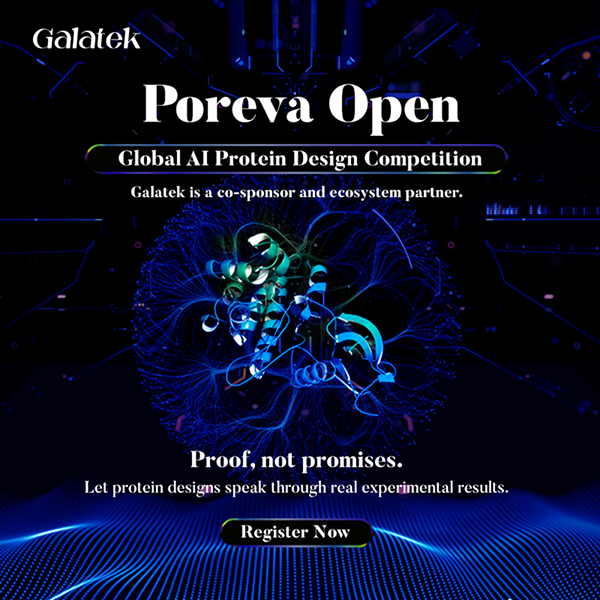
Poreva Open is a new global challenge built around that gap between prediction and result. MegaRobo Technologies launched it with several leading biotech&AI companies and Future Capital & Innoangel Fund, while Galatek and Twist Bioscience are among the co-sponsors and ecosystem partners.
The premise is direct. Submit your designs, and the organizers will put more than 10,000 of them through standardized, double-blind wet-lab validation. Scores come from what happens at the bench.e
Submissions open on October 19, 2026, and the challenge is open worldwide to academic groups, AI teams, biotech companies, and academic labs. Any model, any method. If you build protein design systems, this is an unusually good opportunity to see what they can do under conditions everyone can inspect.
The field has no common yardstick
Teams benchmark against their own targets, their own datasets, their own conditions, their own metrics. When two groups both report state-of-the-art performance, there is often no reliable way to compare them. They ran different experiments and gave the results the same name.
Computational scores also have a habit of not surviving contact with a pipette. A design can look immaculate and never express. Or express and immediately aggregate. Or fold correctly and bind the wrong target. Or hit the right target and do nothing once it reaches a cell.
Poreva Open holds the variables steady. The same problems for everyone, the same experimental system, the same scoring, and rules published and frozen before submissions open.
Questions AI design has to answer
Does a predicted sequence actually work outside the computer? Submissions will go through core validation panels:
• Does it bind its target, and how tightly?
• Does it bind only what it is supposed to?
• Does it bind in the right pH window, and not outside it?
• Does it hold its fold as the temperature climbs?
• Does it behave the same way against the human target and its animal orthologs?
• Does it do anything in a cell?
Following the competition, selected designs that clear the panel advance to harder biology, including organoid models that sit much closer to real physiology than a plate of cultured cells. At that stage binding is table stakes. The evaluation asks whether the protein does something useful in a living system, and whether it holds value as a drug candidate.
Later rounds introduce hidden targets and blind tasks. That removes the advantage of memorized public data and gives a clearer read on how a model handles problems it has never seen.
Somebody has to run 10,000 experiments
All validation happens at Megalaxy Lab, MegaRobo’s automated facility, covering high-throughput expression, purification, binding assays, cell function work and organoids, with samples, procedures and results tracked end to end.
This is the demanding part of the exercise. A generative model can produce ten thousand candidates before lunch. Testing ten thousand candidates under genuinely identical conditions is a different problem, and it is where most benchmarks stop and fall back on computational metrics.
Running all of them through a single pipeline produces a large, consistent dataset mapping design approaches to measured outcomes.

Four rules, published and frozen
1. No moving goalposts. Targets, protocols and scoring are published before submissions open.
2. Double-blind execution. Submissions and experimental work are kept separate, so the teams running the assays do not know whose designs they are testing.
3. Failures published alongside successes. Within IP and compliance limits, samples, results and data go back to the community, including the designs that did not work. That half of the dataset is where much of the practical learning sits.
4. Organizers cannot win. MegaRobo and partner teams may enter, but they are ranked separately and are not eligible for prizes or collaboration opportunities.
Why Galatek is co-sponsor and ecosystem partner
Galatek builds the automation that makes work at this scale possible: liquid handlers, automated cell culture, organoid and synthetic biology systems, high-content imaging, and the orchestration software that runs them as one system.
That gives us a clear view of the wall this challenge is aimed at. Our customers run into it constantly. Design throughput has climbed steeply over the past few years while validation throughput has not, and the gap between them gets measured in pipette tips and calendar weeks.
A public benchmark with real experiments behind it helps everyone working in that gap. Model developers learn what their designs actually do. Pharmaceutical teams get a consistent basis for comparing design systems. The open dataset, failures included, gives the next generation of models something honest to train on.
We are a co-sponsor and ecosystem partner of Poreva Open because validation at this scale is the problem our automation is built to solve.
"We want protein designs judged by experiments rather than by scores. Closing the loop between dry-lab design and wet-lab execution is what Galatek platform was built for. As a co-sponsor and ecosystem partner, our role is to open the competition to the world — and to support you after the results are in: a technical follow-up on your validation data, and a path to take a strong design from validation to scale."
— David Tian, Chief Executive Officer, Galatek
How to enter
Submissions open on October 19. Registration details and the full challenge brief are being published on 18 October through MegaRobo’s official channels, Learn more and register now: https://en.porevaopen.megalaxylab.com/.
The case for entering is straightforward. Running thousands of designs through standardized wet-lab validation sits beyond the budget of most individual groups. Poreva Open covers that cost, publishes the results, and puts the strongest work in front of pharmaceutical partners and investors who are actively looking for it. Teams that do well will have something far more durable than a leaderboard position, which is experimental evidence anyone can check.
About Galatek
Galatek is a Singapore-headquartered automation and AI company serving life sciences and semiconductors. We combine robotics, machine vision, and intelligent software to automate real laboratory workflows, from routine processes through integrated systems for organoid culture, drug screening, synthetic biology, and multi-omics. More at galatek.ai.
Contact Us