We use cookies to improve your experience on our websites and to make visit statistics.

Drugging the Difficult: Insights from ELRIG Drug Discovery USA 2026
June, 2026
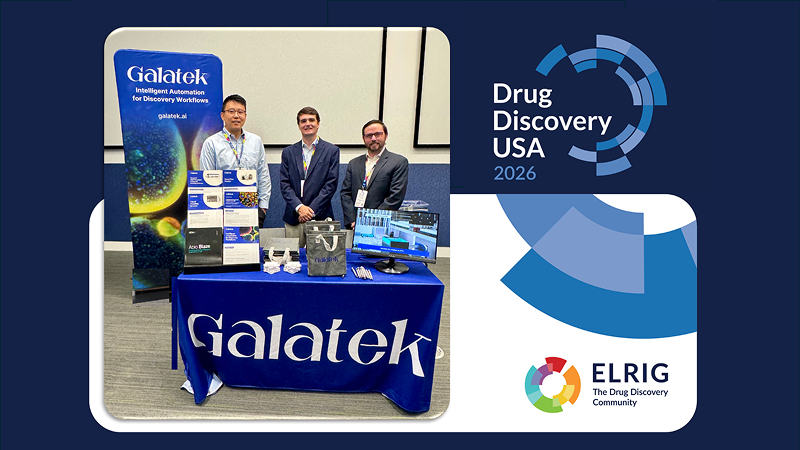
ELRIG (European Laboratory Research & Innovation Group) held its Drug Discovery USA 2026 meeting at Pfizer in Cambridge, MA, from June 16th through the 17th. ELRIG brings together researchers, engineers, and commercial teams from across industry, academia, and the nonprofit sector to discuss developments and trends in drug discovery. This year's theme set the tone for both days: emerging multifunctional small-molecule and biologic approaches to drug difficult targets.
The idea of "drugging the difficult" ran through every session. Thanks to a new generation of modalities, targets long considered out of reach are increasingly more achievable. Approaches such as molecular glues, degraders, engineered antibodies, peptides, and RNA-based therapeutics were talking points that highlighted what has long been inaccessible to patients. Artificial intelligence (AI) was a key thread throughout the event, as both AI models and physical AI have added fuel to the flame of innovation.
Galatek had the pleasure of exhibiting alongside a great mix of recognized suppliers and newer, more specialized entities. Across the floor, vendors showcased everything from cell models and imaging to automation and reagents - all of which are a great reminder of the wide array of needs that exist across this research space.
The Galatek booth hosted many impactful conversations about automation capabilities and the current state of drug discovery. Beyond introducing Galatek to the US market, one idea consistently rang true among attendees: "As the number of drug candidates increases by the power of AI models, how do labs keep up with the demand?"
That specific issue is what we are solving through intelligent automation built for a multitude of different applications. Even though space constraints limited our ability to showcase our platforms (e.g. the Organoid Integrated Platform), we were able to convey our capabilities through case studies and virtual applications.
A great example is our ability to enable automation around preexisting systems. While Galatek provides first-in-class instrumentation such as our liquid handlers and cell imagers, the bigger differentiator is what connects them. Our AI-driven workflows bring intelligence and predictive analytics, which is what turns a collection of instruments into one coherent, data-driven workflow.
Galatek's goal is to enable workflows based on our customers' science — not the other way around. By tackling the hardest limitations, we help science progress and enable scientists to solve the problems of tomorrow.
Follow us on LinkedIn to see where the Galatek will be next!
FAQ
What makes a drug target "undruggable," and is that changing?
Some disease-relevant proteins lack binding pockets or structural features that small molecules and traditional antibodies need to act on. Newer modalities - molecular glues, degraders, engineered antibodies, peptides, and RNA-based therapeutics - are expanding what's considered addressable, opening up targets that were previously out of reach.
Why is the number of drug candidates entering discovery pipelines increasing?
Computational and AI-based methods are accelerating candidate generation earlier in the discovery process, which means labs are seeing a larger volume of candidates that need to move through screening and validation.
How can labs scale throughput without simply adding headcount or new instruments?
Rather than replacing existing equipment, some approaches focus on connecting current lab systems - such as liquid handlers and imaging instruments - into a coordinated workflow, so throughput increases without a full infrastructure overhaul.
Can lab automation be layered onto instruments a lab already owns?
Yes, in some approaches, automation is designed to work around preexisting systems rather than requiring wholesale replacement, which lowers the barrier for labs looking to scale up existing capabilities.
Contact Us